
Choose the Privacy Problem Before Choosing a Feature
HSV dating site privacy features are useful only when they address the exposure you want to reduce. Public search visibility, unwanted messages, photo sharing, phone notifications and account deletion are different concerns. A service describing itself as private does not settle all of them.
Start with a short personal priority list. You may want to keep a profile out of a public search engine, choose when a date sees a photograph, or prevent message text appearing on a shared device. Name the specific concern so you can ask a specific product question.
For example, a private album may help control who initially receives a photo. It does not tell you whether your main profile is public or what someone can do after seeing that image. Comparing features by their actual purpose makes the product description more useful and keeps a reassuring label from becoming an unsupported guarantee.
Profile Visibility and Public Search Are Different Layers
Ask whether a profile is visible before registration, whether members can discover it after joining, and whether there are settings that change that visibility. These are distinct layers. Being behind a login is not the same as being invisible to another member.
Do not infer an account's exposure from a homepage screenshot. The current logged-in settings and the service's own explanation should tell you what a control changes. If a setting has a broad name such as hidden or private, examine its scope before relying on it.
You can also reduce what the profile reveals independently of those tools. Avoid an employer name, a daily routine, a home address or an image with a recognizable workplace badge. The HSV safety guide covers those ordinary information choices. A platform control and careful disclosure can work together without becoming interchangeable.
Private Photos Limit Access, Not Every Later Use
A private-photo control can help decide who sees an image through the service. After access is granted, the viewer may still be able to save, photograph or describe it. Do not treat a product interface as a promise that an image can never leave that interface.
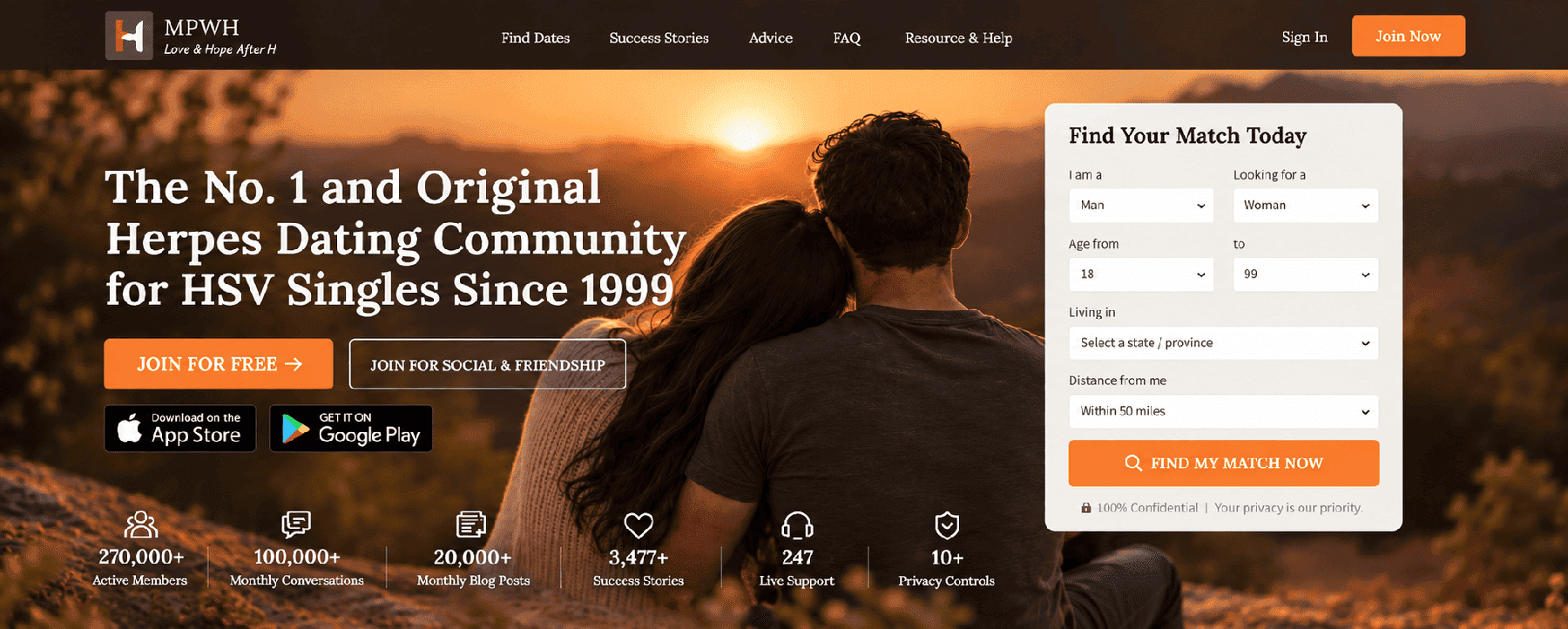
MeetPositives publicly describes locked private albums with access granted to selected matches. MPWH describes controls around profile and photo visibility. PositiveSingles presents a range of privacy tools. Those descriptions make the services relevant to comparison, while the exact account controls and access boundaries should be understood in the current product.
Consider what the image itself reveals before sharing it. A face photo can support an attractive profile; a workplace badge, a child, or a location visible through a window can add unrelated identifying detail. Choose the amount of information you want a match to receive, then use the appropriate control rather than expecting it to erase the image's content.
Contact Restrictions Need a Clear Outcome
Blocking, reporting and deciding who may contact you serve different purposes. Blocking generally addresses an individual connection; reporting asks a service to examine behavior; a contact preference may affect which introductions reach you. Learn what the particular product does instead of assuming all controls share one outcome.
If someone pressures you, asks for money, or threatens to expose health information, stop providing additional details. Save what you may need to explain the problem before deleting an exchange, and use the service's current reporting route. You do not have to continue a conversation to demonstrate that you are reasonable.
A report is not a promise about the timing or result of moderation. If you need immediate personal support or face a credible threat, use an appropriate local professional or emergency route. A dating site's contact tools are not a substitute for every form of assistance.
Device Notifications Are Your Own Privacy Layer
An account can have useful privacy settings while a phone displays messages to someone nearby. Review notification previews and device access separately from profile visibility. The concern is particularly practical when a device is shared or regularly sits unlocked in view.
You can keep an app convenient while choosing when to see message content. Operating systems and device manufacturers offer different controls, so use the settings available on your own device. Avoid describing one phone's feature as a verified control provided by every dating app.
Your choice of iPhone dating apps or Android dating apps also affects how you use these controls on a phone. A download choice should fit your dating needs; device privacy should support that choice without turning the entire experience into a settings task.
Account Deletion Is Not the Same as Subscription Cancellation
Deleting a dating account, canceling a paid subscription and uninstalling an app can be separate actions. Establish what you want to stop: public or member visibility, stored account activity, a future charge, or access from the device. Then follow the route for each relevant action.
A website and an app-store purchase may have different management paths. Removing the app does not by itself establish that a billed membership has ended. Likewise, canceling renewal does not necessarily remove a profile. Read the applicable instructions while you still have access to the account.
Privacy policies also describe retention and other data-handling issues that a single delete button cannot explain. If deletion is a major reason for your choice, identify the current service contact and the request path before joining. Avoid providing unnecessary sensitive documents to an unverified support address.
Compare Controls Through the Decisions They Support
| Your Priority | Useful Product Question | Limit to Keep in View |
|---|---|---|
| A discreet profile | Who can discover it before and after registration? | A member may still recognize you. |
| Selective photo sharing | Can I grant and revoke access? | Earlier recipients may retain a copy. |
| Less unwanted contact | What do block and report actually change? | No moderation system prevents every message. |
| A private phone screen | Which previews can I hide on my device? | Device settings and app settings are separate. |
| Leaving the service | How do account deletion and billing cancellation differ? | Uninstalling is not proof that either is complete. |
Use the five-site comparison to choose a community with relevant positioning, then examine the controls that matter to you. Privacy is also a relationship agreement: a partner may need a separate conversation about sharing your health history, photographs or relationship status.
Discuss different privacy preferences in relationships before assuming a partner shares your boundaries. A product can help control an account; it cannot decide what another person is permitted to tell friends or family without your consent.
The strongest starting choice is a service whose controls you understand and can use alongside your own information boundaries. That can preserve room for an appealing dating profile and genuine conversation while keeping the details you want private under more deliberate control.